Wednesday, February 29, 2012


Thursday, December 22, 2011
Monday, December 5, 2011
Thursday, June 16, 2011
Friday, March 25, 2011
Friday, February 11, 2011
France Day Three
Continuing our adventure in the Loire Valley we visited the region of Vouvray to tour the Troglodytes Caves and sample the wines of Domaine des Lauriers. We were joined by Thierry Delaunay, the owner of Domaine Delaunay in the Touraine region of the Loire, and Jean Thomas, owner of Domaine Thomas et fils from the Sancerre region.

(Vouvray)
Vouvray: Just north of the Loire River lies the region of Vouvray. The wines produced in this region are made with almost entirely Chenin Blanc (small amounts of the Arbois grape are allowed, though it is rarely used) and range in styles from dry to sweet, still to sparkling. Wine has been produced in this region for centuries, and legend has it that Saint Martin of Tours developed the viticulture there, and perhaps even introduced the Chenin Blanc grape to the region. The Vouvray AOC was designated in 1936.

(Lunch in the Troglodytes Caves)
Troglodytes: Caves dug into a hillside. Cave cellars offer the advantage of a temperature and humidity constant.

(Laurent Kraft)
Domaine des Lauriers: The Kraft family has owned the winery for 7 generations. Laurent Kraft, who practices sustainable agriculture, took over the estate in 1992. The vines are planted on the banks of the Loire River, and 90% of them are between 30 and 90 years of age.

(Thierry Delaunay)
Domaine Delaunay: Located on the bank of the Cher River, about 30 miles east of the city of Tours. It has belonged to the same family for 5 generations and is now run by Thierry Delaunay. Practicing sustainable agriculture, Domaine Delaunay is the perfect combination of modern technique and long-lived traditional winemaking.

(Jean Thomas)
Domaine Thomas et fils: The Thomas family has been making wine in the famous appellation of Sancerre for more than ten generations. Jean and Ginette Thomas are the current proprietors. Dedicated almost exclusively to Sauvignon Blanc, the Thomas family owns about 33 acres of vines which average 35 years of age. All of the grapes are hand-harvested.

(First Course)
First course: Crawfish over greens with grapefruit and orange in a raspberry vinaigrette paired with Domaine Thomas Sancerre “La Crele.” The crisp Sauvignon Blanc, with its bright lemon lime zest aromas and flavors, paired well with the rich shellfish and the acidity of the vinaigrette.

(Main Course)
Main course: Potatoes over braised beef in a mushroom sauce with Delaunay Touraine Rouge l’Antique des Cabotieres. The elegant dark cherry notes within the lighter bodied Touraine seemed to wake up the heavy comfort food, which on a 35 degree day was quite welcome.

(Cheese Course)
Cheese: Herb encrusted goat and Montbriac Rochebaron with Domaine des Lauriers Vouray Moelleux. The residual sugar of the wine tamed the sharpness of the blue while the lively acidity sliced through the creamy goat.

(Dessert)
Dessert: Crème Brulee, chocolate macaroon, and fresh fruit accompanied by a fresh cup of coffee. A wonderful end to a delicious lunch.
Friday, January 28, 2011
France Day Two (pm)
France Day Two (pm)
For the evening the Robert Kacher team took it easy on us. We retired to our hotel for a night of Muscadet with the perfect pairing oysters, a traditional Loire buffet and to end the evening Calvados.
For the evening the Robert Kacher team took it easy on us. We retired to our hotel for a night of Muscadet with the perfect pairing oysters, a traditional Loire buffet and to end the evening Calvados.


(Laurence and Gerard Vinet)
Domaine Vinet
Le Domaine Vinet was created in 1948 by Gustave Vinet. Today his two sons Daniel and Gérard, in assistance with Laurence Vinet, help to perpetuate his passion for the vine and wine. Located in the Loire Valley, near the Atlantic Ocean, they own and operate 60 acres of vines in the heart of the appellation Muscadet Sèvre et Maine, the best ripening area for the Muscadet grape (also known as Melon de Bourgogne).
Domaine de la Quilla: Muscadet de Sevre et Maine sur Lie 2009
Domaine de la Quilla is located in the village of La Haie-Fouassiere. Apparently this village is the origin of the famous wines of Muscadet. The Vinet's keep the wines "sur lie", or on the yeasts, for eight months before bottling. - Fragrant aromas and flavors of pear. 100% Muscadet.
Domaine Saint Martin: Muscadet de Sevre et Maine sur Lie 2009
Purchased by the Vinet's in 2000, Domaine Saint Martin is located in the commune of Chateau Thebaud, on the edge of the Maine river. Unusual for the Muscadet region, the Domaine covers 8 hectares on one lot. It was started in 1830 and documents show that a monk may be at the origin of the property. - Polished, with intense lemon lime zest followed by a clean finish. 100% Muscadet.
Clos de la Houssaie: Muscadet de Sevre er Maine sur Lie 2009
Clos de la Houssaie is a 1.7 acre vineyard located in the village of La Haye-Fouassiere and surrounded by a small stoned wall, which gives the grapes an ideal micro-climate to reach their peak maturity level. The Vinet's harvest and vinify these grapes separately from their other vineyards. - Mineral notes in the bouquet and palate. 100% Muscadet.

(Jerome Dupont)
Domaine Dupont Calvados
Located in the very heart of the Pays d’Auge in Normandy, the domaine is run by third generation Etienne Dupont since 1980, when he took over from his father Louis and his grand-father Jules. His son Jérôme joined the domaine in 2002. Over the years, Etienne improved the old orchards and planted a further ten hectares of small standard apple trees. Together there are 27 hectares of typical varieties, that is to say 9000 apple trees. Following the traditional methods of producing Calvados, the apples are hand-picked and rest in open wooden boxes called pallox to reach their highest aromatic peak. The juice is slowly extracted under low pressure and kept on its lees for 2 months to prevent any alteration of the cider’s flavor. The apple cider then undergoes a double distillation through a sophisticated Chalvignac copper still. The spirit is aged in 400 liter casks, made from Loire Valley oak, slightly toasted to provide vanilla aromas to the finished product.
Wednesday, January 26, 2011
France Day Two (am)
Day Two (am)
We set out for the town of Anjou in the Loire region to be welcomed by the Duke of Brissac at his castle. Known as the tallest castle of France, Brissac with its seven stores and 204 rooms, is named as “The Giant of the Loire Valley”. Acquired in 1502 by René de Cossé, first Lord of Brissac, today it is the residence of the 13th Duke of Brissac. To learn more: www.chateau-brissac.fr . At the castle we tasted the wines of Domaine des Hauts de Sanziers, Domaine Les Grandes Vignes, Domaine des Rochelles, and Château de Suronde.
 (Chateau Brissac)
 (l.Dominique Tessier, c. The Duke of Brissac, r. Antoine Songy of Robert Kacher Selections)
 (Jean and Dominique Tessier)
Domaine de Hauts de Sanziers
Located south of Saumur, the Domaine des Hauts de Sanziers has belonged to the Tessier family for 2 centuries. Today the estate covers 85 hectares in the appellations of Saumur and Saumur-Champigny, all worked organically and covered with grass. The soils there are clay and limestone.
Saumur brut Houet & Tessier NV – Not currently available in the US. A bright sparkling wine with lemon and lime notes. 60% Chenin Blanc, 30% Cab Franc, and 10% Chardonnay.
Methode Traditionnelle NV – Not currently available in the US. 100% Cab Franc red sparkling wine with bright strawberry flavors.
Saumur Blanc Hauts de Sanziers 2010 – Lemon zest with a lingering lime finish 100% Chenin Blanc.
Saumu Rouge Hauts de Sanziers 2010 – Light strawberry flavors with a delicate finish 100% Cabernet Franc.
 (Jean-Francois Vallant)
Domaine les Grandes Vignes
The Domaine Les Grandes Vignes goes back to the 17th century, and has been in the Vaillant family ever since. The Vaillant family owns 55 hectares in the appellations of Anjou, Bonnezeaux, and Coteaux du Layon, and has been working organically since 2006.
La Varenne du Poirier Anjou Blanc 2010 – Peach scents and palate 100% Chenin Blanc.
Les Cocainelles Anjou Rouge 2009 – Plum notes accent this lighter style red 100% Cabernet Franc.
Rose d’Anjou 2010 – Crisp strawberry flavors.
 (Jean-Yves Liberton)
Domaine de Rochelles
Roches des Rochelles Anjou Blanc 2009 – The slate soils show through with a mineral and lime essence 100% Chenin Blanc.
Les Millerits Anjou Villages Brissac Rouge 2009 – Flavors of red licorice and cassis in this weightier offering.
La Croix de Mission Anjou Villages Brissac Rouge 2009 – Lighter in style with red fruit and a slight tannic grip on the finish.
 (Guillame MORDACQ)
Château de Suronde
Quart de Chaume 2003 - A rich honeyed wine with layers of peach fruit and a lingering finish.
Quart de Chaume 1997 – The honey shows through a slight oxidized brown sugar flavor.
Monday, January 10, 2011
France Day One
Greetings,
I landed in Paris on Monday morning and rendezvoused with the gang from Robert Kacher Selections at the Place De La Nation square. Robert Kacher, who represents the wineries I will be visiting and tasting, is an importer specializing in small family owned wineries from France. We Saddled up and headed three hours southwest to the town of Saumur in the Loire Valley.
If you would like to play where’s mike? here is a map link:
View France Day One in a larger map

(View of the Loire River from Saumur)
Our first dinner was hosted by the very gracious husband and wife team of Kathleen Van den Berge and Sigurd Mareels, new owners of Chateau de Miniere in the region of Bourgueil. The estate, which dates back to the 16th century, has been handed down through a line of women for two centuries. In keeping with this tradition Kathleen will be in charge of the estate, while her husband pursues his career in mining consulting. The purchase of the estate was completed in 2010, but the current owners began involvement with the 2009 vintage and have retained wine maker Daniel Esteve. The estate is in the second of the four year process required to obtain their organic certification.

(Two generations of Chateau de Miniere)

(Sigur and Sofie Mareels with Yours Truly)
In addition Denis Pommier, owner of Domaine Denis Pommier form the Burgundy region of Chablis joined us for dinner. Denis established the domaine in 1990 with the inheritance of 2.5 hectares of Chablis vineyards from his grandfather. Today the estate encompasses 13 hectares. All white Burgundies from the Chablis village are made using the Chardonnay grape.

(l.Edward Labaye of Robert Kacher Selections & r.Denis Pommier)
We tasted Denis’:
2008 & 2009 Petit Chablis ($18.99*) – Both showed bright lemon on the nose that followed to the palate. The 2008 was a bit tighter while the 2009 was more welcoming, but with a little less punch. Both done in stainless steel.
2008 Chablis – Lemon and lime on the nose with hints of grapefruit arriving on the palate with a longer finish.
2008 Chablis single premier cru vineyard “Beauroy” ($29.99) - Contained all the citrus zest of Chablis with a light butterscotch note.
2008 Chablis “Cote de Lechet 1er Cru” – added rich pineapple flavors to the mix.
2009 Chablis “Croix aux mons” – Fruit was more forward, but not as rich as the 2008’s.
And a rare look at his:
Pinot Noir Bourgogne – had light red cherry flavors with a bit of tangy orange peel.
Kathleen poured her 2009 vintage out of barrel. The 2009 vintage is being heralded as a blockbuster in Bourgueil. Cabernet Franc is the only allowed grapes to be used in red Bourgueil. In general Cab. Franc is a light to medium bodied grape, which is less commonly seen as a single varietal, more often used as a blending grape in Bordeaux styled wines.
2009 “Chateau” – Showing Cab. Franc’s elegance with lively dark cherry and raspberry flavors. The finish contained a pleasing light tannic grip. The vineyards sourced are on average 15 years old.
2009 “Vielle Vignes” – meaning old vines. Sourced from 45 year old vineyards. A bit more concentrated flavor, with the tannins becoming more prominent, giving it a significant aging potential. The scheduled spring bottling should provide the time for additional polishing from barrel aging.
And a special treat, the first public tasting of a new bottling not previously produced, the 2009 “Cuvee Centenaire” – Coming from hundred year old vines comprising a single Hectare section of the vineyard. A darker fruit nose with raspberry and licorice flavors that trail off into a long finish with significant tannins. This limited cuvee will, depending on the wines progression, see bottle in the fall.
 First Course: Coquille Saint Jacques – Scallops, shrimp, crawfish and mussels in a rich cream sauce served in a pastry shell. The heftier premier crus Chablis’ held up well to the rich flavors, while the crisp acidity gave a lively lift to the succulent seafood.

 Dessert:
Crème’ Brulee and a Pear Tarte Tatin. I prefer to enjoy sweets on their own or with coffee.
I hope you enjoyed the first day. Get some rest, we start early tomorrow with a visit to a castle.
Regards,
Mike
I landed in Paris on Monday morning and rendezvoused with the gang from Robert Kacher Selections at the Place De La Nation square. Robert Kacher, who represents the wineries I will be visiting and tasting, is an importer specializing in small family owned wineries from France. We Saddled up and headed three hours southwest to the town of Saumur in the Loire Valley.
If you would like to play where’s mike? here is a map link:
View France Day One in a larger map

(View of the Loire River from Saumur)
Our first dinner was hosted by the very gracious husband and wife team of Kathleen Van den Berge and Sigurd Mareels, new owners of Chateau de Miniere in the region of Bourgueil. The estate, which dates back to the 16th century, has been handed down through a line of women for two centuries. In keeping with this tradition Kathleen will be in charge of the estate, while her husband pursues his career in mining consulting. The purchase of the estate was completed in 2010, but the current owners began involvement with the 2009 vintage and have retained wine maker Daniel Esteve. The estate is in the second of the four year process required to obtain their organic certification.

(Two generations of Chateau de Miniere)

(Sigur and Sofie Mareels with Yours Truly)
In addition Denis Pommier, owner of Domaine Denis Pommier form the Burgundy region of Chablis joined us for dinner. Denis established the domaine in 1990 with the inheritance of 2.5 hectares of Chablis vineyards from his grandfather. Today the estate encompasses 13 hectares. All white Burgundies from the Chablis village are made using the Chardonnay grape.

(l.Edward Labaye of Robert Kacher Selections & r.Denis Pommier)
We tasted Denis’:
2008 & 2009 Petit Chablis ($18.99*) – Both showed bright lemon on the nose that followed to the palate. The 2008 was a bit tighter while the 2009 was more welcoming, but with a little less punch. Both done in stainless steel.
2008 Chablis – Lemon and lime on the nose with hints of grapefruit arriving on the palate with a longer finish.
2008 Chablis single premier cru vineyard “Beauroy” ($29.99) - Contained all the citrus zest of Chablis with a light butterscotch note.
2008 Chablis “Cote de Lechet 1er Cru” – added rich pineapple flavors to the mix.
2009 Chablis “Croix aux mons” – Fruit was more forward, but not as rich as the 2008’s.
And a rare look at his:
Pinot Noir Bourgogne – had light red cherry flavors with a bit of tangy orange peel.
Kathleen poured her 2009 vintage out of barrel. The 2009 vintage is being heralded as a blockbuster in Bourgueil. Cabernet Franc is the only allowed grapes to be used in red Bourgueil. In general Cab. Franc is a light to medium bodied grape, which is less commonly seen as a single varietal, more often used as a blending grape in Bordeaux styled wines.
2009 “Chateau” – Showing Cab. Franc’s elegance with lively dark cherry and raspberry flavors. The finish contained a pleasing light tannic grip. The vineyards sourced are on average 15 years old.
2009 “Vielle Vignes” – meaning old vines. Sourced from 45 year old vineyards. A bit more concentrated flavor, with the tannins becoming more prominent, giving it a significant aging potential. The scheduled spring bottling should provide the time for additional polishing from barrel aging.
And a special treat, the first public tasting of a new bottling not previously produced, the 2009 “Cuvee Centenaire” – Coming from hundred year old vines comprising a single Hectare section of the vineyard. A darker fruit nose with raspberry and licorice flavors that trail off into a long finish with significant tannins. This limited cuvee will, depending on the wines progression, see bottle in the fall.
Dinner:
Hors d’oveurs:
Belgian endives stuffed with shellfish salad - The bitterness of the endive paired very nicely with the crispness of the Petit Chablis.
Traditional Quiche - The brightness of the Chablis cut through the creaminess of the egg and cheese.Belgian endives stuffed with shellfish salad - The bitterness of the endive paired very nicely with the crispness of the Petit Chablis.
 First Course: Coquille Saint Jacques – Scallops, shrimp, crawfish and mussels in a rich cream sauce served in a pastry shell. The heftier premier crus Chablis’ held up well to the rich flavors, while the crisp acidity gave a lively lift to the succulent seafood.
Second Course:
Roasted young chicken and roasted chestnuts with caramelized onions in mushroom gravy accompanied by a pastry filled with garlic buttered potatoes – The complex Cuvee Centenaire blended well with the smoky flavors of the chicken and calmed some of the woodsy nutty notes of the chestnuts.
Cheese Course:
Warmed Roquefort over sliced pair – the lighter red fruit of the “Chateau” worked well to take some of the bite out of the blue cheese.
Warmed Roquefort over sliced pair – the lighter red fruit of the “Chateau” worked well to take some of the bite out of the blue cheese.
 Dessert:
 Crème’ Brulee and a Pear Tarte Tatin. I prefer to enjoy sweets on their own or with coffee.
I hope you enjoyed the first day. Get some rest, we start early tomorrow with a visit to a castle.
Regards,
Mike
Tuesday, November 30, 2010
1996 E Pira-Chiara Boschis Barolo Cannubi

1996 E Pira-Chiara Boschis Barolo Cannubi
At the store I am often asked what is my favorite wine. I usually avoid the question with the explanation that it depends on the food I am eating, the time of year, etc. When I look back at wines I buy and order in restaurants a pattern does emerge and Barolo is up on the list. This 1996 was no let down to my fondness for the wines.
Some Definitions:
E Pira-Chiara Boschis - The Producer
Barolo - A region of Piedmont in the north of Italy
Cannubi - A vineyard in Barolo, portions of which are owned and sourced by multiple wineries, so you will see more than one Barolo Cannubi.
Nebbiolo - The grape used in Barolo
Barolo is considered by many to be the king of Italian wines, but it is not a monstrous brute, rather an elegant complex expression of Nebbiolo. The E. Pira nose sprang from the glass with bright raspberry, violet and a back note of earthiness. The wine showed a bright garnet color with a lacquered top. Layers of dark cherry, raspberry, leather and tobacco straight through the long finish. Cellar note: A wine drinking well, but still youthful with easily 10-15 years left.
First course was a Ravioli of duck and Ricotta in a Porcini cream sauce. The acidity of the wine cut through the cream of the sauce and cheese nicely, leaving the mushroom to mingle with the earthiness and tobacco notes of the Barolo.
Second course was a braised lamb shank with creamy polenta in a sweet pepper and mushroom ragu. The powerful flavors of the dish met the complexity of the Nebbiolo. Some of the higher tone fruit in the wine melted into the background while darker fruit flavors of current and raisin showed up. The wine washed away the acidity of the ragu showing off the savory notes of the lamb. A perfect example of a wine with a moderate 13.5% alcohol (lower than a Cab or Shiraz) taking on a big dish and complementing it beautifully to the benefit of both the food and the wine.
Monday, October 18, 2010
Dinner with George Sandeman at The Milton Inn

I had the pleasure to dine with George Sandeman the seventh generation of The House of Sandeman. I always enjoy nontraditional food and wine pairings, port being thought of as a dessert wine was a prime candidate. Chef Brian Boston was up to the task. ( http://www.miltoninn.com/ ) I was fortunate to be seated with Chef Galen Sampson and his wife Bridget of The Dogwood ( http://www.dogwoodbaltimore.com/ ) who gave a chefs perspective on approaching this type of dinner.
When wines are currently available I will put pricing in the descriptions. Because George was so gracious to buy dinner, all Sandeman’ s wines will be discounted 20% from the listed prices through the end of the year.

Don Fino Superior Fino Sherry ($15.99)
Shellfish Soup with tarragon, roasted garlic and Don Fino Sherry
On its own the Sherry was light and pleasant with slight almond flavors. Paired with the cream of the soup it really showed up with pear and apple fruit coming forth. A great combination.


Sandeman 10 & 20 year old Tawny Porto ($22.99 & $45.99)
Pan Seared Hudson Valley Foie Gras with a Samdeman 20 year old Tawny reduction and Foie Gras oil, prosciutto, chive crispy polenta and caramelized shallots.
This was a great combination of sweet paired with savory. On their own the ports showed nice flavors of walnut and raisin. The 10 year had a bit more tannic grip. The 20 year was a lighter amber color. The rich flavors of the Foie Gras brought out more of the dried fruit notes. The Foie Gras took on a creamier texture with flavors lingering longer beside the port.


Sandeman 30 & 40 year old Tawny Porto ($59.99 & $119.99)
Fennel Pollen, Hazelnut and Pepper Dusted Venison Chop with fig, 40 year Tawny reduction, beet, truffle risotto, sautéed wild mushrooms and asparagus.
The ports showed the mellowing effects of their age. It was interesting that the 40 year possessed the most acidity, making it the best match for the venison. The earthiness of the truffle was a particular treat matched with the well dried fig and apricot flavors of the Port.

2007 Sandeman Vintage Porto ($89.99)
Chocolate Trio – Dark chocolate truffle, chocolate macadamia torte and chocolate pot de crème with 2007 vintage Porto Syrup.
Vintage port, in my opinion, has changed styles over the years. If you tasted the classic 1977 vintage in 1980 you would be wasting the wine. In those years the port took years to mellow. 30 years later it is just coming into its own. This 2007 is made in a much more approachable manner. The raspberry and currant notes boom forward. The wine will definitely benefit from aging, allowing the more subtle flavors to show through.
I am not particularly fond of pairing sweet wine with a sweet desert. I know many think of chocolate as a match for port, but it seemed that the chocolate washed a good deal of the fruit from the port leaving it bitter and astringent. I would prefer the port and the desserts on their own.
I am not particularly fond of pairing sweet wine with a sweet desert. I know many think of chocolate as a match for port, but it seemed that the chocolate washed a good deal of the fruit from the port leaving it bitter and astringent. I would prefer the port and the desserts on their own.

2004 Late Bottled Vintage Porto ($31.99)

Tuesday, October 12, 2010
Tailgating at the Ravens Game

2004 Domaine Belland Criots-Batard-Montrachet -Tight and young, the nose had a slight almond and pear aroma. Pineapple and butter on the rich palate. The fruit is there, but it is hiding. I believe this will be a great wine once it comes in to its own. Cellar Note: Hold for at least 2 years, should drink well 2-7 years.

2002 Domaine Hudelot-Baillet Chambolle-Musigny Les Charmes
*** Cork Dork Alert ***
I will give everyone fair notice when I am about to venture into the area of too much information.
Today’s topic: Bottle Variation
How is it that two bottles of wine from the same case can taste vastly different? Many reasons which stem from the fact that wine is a living evolving substance that include, but are not limited to:
The Cork
• If it is a natural cork, the seal and density may vary allowing different amounts of oxygen to seep through. This will cause two bottles stored under the same conditions to taste different.
• It may contain the defect TCA (2,4,6-Tribromoanisole) a fungus that gives wine a wet paper bag smell and robs the wine of fruit flavors.
The Bottle
• Residue from cleaning fluids may be left.
• Live yeast in the bottle can cause a second fermentation to occur in the bottle causing the wine to be fizzy.
• Barrel Variation. One bottle could be filled from a different barrel than another.
And finally what I experienced Sunday. The first bottle we opened had a pronounced earthy barnyard scent that was mixed with scents of dark cherry which you would expect from a world class Pinot Noir. The barnyard was there when the wine was tasted, but the dark cherry and red licorice also showed through. My guess is the presence of Brettanomyces or Brett., a yeast that will produce that barnyard effect. The yeast can live in the barrels or in the winery. Some winemakers like Brett. in small amounts. They feel it gives the wine an added layer of complexity.
• Residue from cleaning fluids may be left.
• Live yeast in the bottle can cause a second fermentation to occur in the bottle causing the wine to be fizzy.
• Barrel Variation. One bottle could be filled from a different barrel than another.
And finally what I experienced Sunday. The first bottle we opened had a pronounced earthy barnyard scent that was mixed with scents of dark cherry which you would expect from a world class Pinot Noir. The barnyard was there when the wine was tasted, but the dark cherry and red licorice also showed through. My guess is the presence of Brettanomyces or Brett., a yeast that will produce that barnyard effect. The yeast can live in the barrels or in the winery. Some winemakers like Brett. in small amounts. They feel it gives the wine an added layer of complexity.
The second bottle we opened was gorgeous with all the fruit flavors I mentioned, but with a clean nose and taste. This was a truly great bottle of wine. If it was Brett, it is possible that we tasted wines from two different barrels, one with a greater prevalence of Brett. than the other.
Here is the dilemma. The presence of the listed defects can vary. If it is blatant the bottle can be returned to the shop or sent back at a restaurant. In this case, if we did not have the second bottle, I would assume that it was characteristic of the wine. Even tasting the great second bottle do you spend the money on an $80 bottle of wine and take the risk? On the other side when you are dealing with small producers that are not overly filtering their wines and making profoundly great wines you get blemishes. What do you think?

2003 Thierry Beaumont Morey Saint Denis Les Sorbes – A big ripe generous Pinot showing the heat of the vintage. Plum fills the nose; flavors of chocolate covered cherries abound in the rich palate. Not your traditional elegant Burgundy. Cellar Note: Enjoy over the next 5-10 years while your classic 2002’s mature.
Wednesday, October 6, 2010
First Post
Here goes my try at being a blogger. Two friends and I met for dinner. Here is what we drank:

1999 Kistler Chardonnay Durell Vineyard – Wow this is a big rich Chardonnay that has aged nicely showing a good amount of oxidation. The nose is full of rich toffee, which follows through to the palate. Anything that might have resembled buttered popcorn has mellowed into caramel toffee and crème brulee. Good acidity still exists making the wine lively. Celler note: I would be drinking now, better a year too early than a year too late.

1999 Dominique Laurent Grands Exhezeaux – Drinking Burgundy is like playing golf. There are frustrating wines that are overpriced and underperform, but then you come across a wine that makes you forget the bad shots and keeps you coming back. This Pinot was bursting with bing cherries mellowing to a backbone of lingering leather notes. The finish was long lasting and the wine seemed youthful for its age. Paired beautifully with a Maryland Style Lump Crab Cake accompanied by a basil vinaigrette, tomato-olive relish. Cellar note: Still in great shape could last another decade.
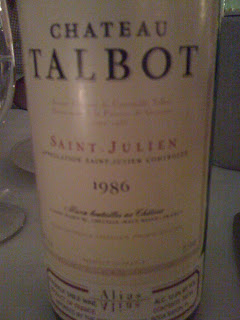
1986 Talbot – Generous plum and cassis scents and flavors flow from this blend. The finish lasts featuring anisette and heather. Think comfy chair and slippers. Cellar note: Still youthful, drink now or let it mature for 15 years.

1989 Domaine du Vieux Telegraphe Chateauneuf du Pape – I must admit I am fan of Vieux Telegraphe, but had not tasted this far back. The style is much more restrained with very soft tannins compared with the brutes of latter vintages. Silky flavors of blackberries with a well tanned glove leather finish. Cellar note: A wine in its prime which should last for another 10 to 15 years.
1999 Kistler Chardonnay Durell Vineyard – Wow this is a big rich Chardonnay that has aged nicely showing a good amount of oxidation. The nose is full of rich toffee, which follows through to the palate. Anything that might have resembled buttered popcorn has mellowed into caramel toffee and crème brulee. Good acidity still exists making the wine lively. Celler note: I would be drinking now, better a year too early than a year too late.
1999 Dominique Laurent Grands Exhezeaux – Drinking Burgundy is like playing golf. There are frustrating wines that are overpriced and underperform, but then you come across a wine that makes you forget the bad shots and keeps you coming back. This Pinot was bursting with bing cherries mellowing to a backbone of lingering leather notes. The finish was long lasting and the wine seemed youthful for its age. Paired beautifully with a Maryland Style Lump Crab Cake accompanied by a basil vinaigrette, tomato-olive relish. Cellar note: Still in great shape could last another decade.
1986 Talbot – Generous plum and cassis scents and flavors flow from this blend. The finish lasts featuring anisette and heather. Think comfy chair and slippers. Cellar note: Still youthful, drink now or let it mature for 15 years.
1989 Domaine du Vieux Telegraphe Chateauneuf du Pape – I must admit I am fan of Vieux Telegraphe, but had not tasted this far back. The style is much more restrained with very soft tannins compared with the brutes of latter vintages. Silky flavors of blackberries with a well tanned glove leather finish. Cellar note: A wine in its prime which should last for another 10 to 15 years.
Subscribe to:
Posts (Atom)